Why Everything Is an Object in Python
One of the first things that breaks intuition in Python is the claim that everything is an object. Integers have methods. Functions are values. Classes themselves can be passed around and inspected at runtime.
This feels elegant, but it also feels suspicious. In many languages, primitive values are deliberately kept separate from objects to avoid overhead. Python refuses that separation.
The result is a recurring sense that Python is doing “too much” for simple operations. Arithmetic feels heavier than expected. Memory usage grows faster than similar programs in other languages.
This behavior is not accidental. It follows directly from Python’s object model and the tradeoffs that model enforces.
Short Summary
Python treats every value as an object, including integers, booleans, functions, and classes.
This unified object model enables powerful runtime features such as late binding and introspection, but it also introduces consistent overhead in memory, indirection, and dynamic dispatch.
Understanding this tradeoff explains why simple operations feel heavier in Python and why its performance characteristics differ fundamentally from languages with primitive value separation.
Summary Card
Why Everything Is an Object in Python
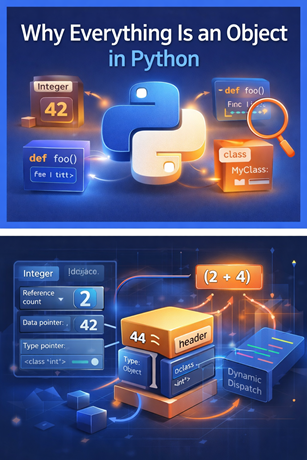
- Python enforces a single, uniform object model for all values, including those that are primitives elsewhere.
- This uniformity enables late binding, introspection, and pervasive runtime flexibility.
- Every value carries object metadata, which increases memory footprint and indirection.
- Most operations rely on dynamic dispatch rather than direct machine instructions.
- The design prioritizes semantic consistency over raw execution efficiency.
Problem definition
In Python, values that are primitives in other languages behave as full objects.
An integer has identity, reference counting, and a type object that defines its behavior. A boolean is not a CPU flag. It is an object with methods and metadata.
This becomes visible when performance matters. Numeric loops allocate and discard objects. Simple arithmetic triggers method resolution. Memory usage scales with object count rather than value size.
The confusion arises because Python’s syntax suggests low level operations, while its execution model is entirely object driven.
The common wrong assumptions
A common assumption is that Python integers are lightweight values stored directly in registers or on the stack.
Another assumption is that methods on primitive looking values are resolved statically or optimized away.
Both assumptions are incorrect. Python does not have a conceptual distinction between primitive values and objects at the language level.
Once this mental model breaks, the observed performance characteristics stop being surprising.
What actually happens inside Python
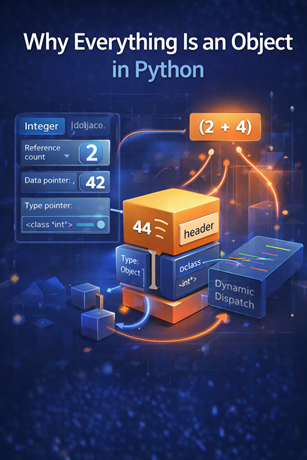
In CPython, every value is a heap allocated object with a common header.
This header contains a reference count and a pointer to a type object. The type object defines behavior through function slots for operations such as addition, comparison, and hashing.
When an expression like a + b executes, Python does not emit a direct arithmetic instruction. It performs a dynamic lookup on the type of a and dispatches to the appropriate implementation.
This mechanism is uniform. It applies to integers, strings, user defined types, and even classes themselves.
The cost structure follows directly from this design.
- Allocation cost for every value that must exist as a heap object.
- Indirection cost to reach the actual data through object pointers.
- Dispatch cost for resolving behavior at runtime rather than compile time.
These costs are predictable and consistent, but they are always present.
Why Python is designed this way
Python’s object model is a deliberate tradeoff.
A single semantic model simplifies the language. Every value follows the same rules. Introspection, operator overloading, and dynamic modification all fall out naturally.
Late binding is central. Behavior is resolved at runtime, which enables patterns that would be difficult or impossible in languages with strict primitive separation.
The cost is execution efficiency. Python accepts higher memory usage and slower primitive operations in exchange for consistency and flexibility.
Anti patterns that make it worse
Some usage patterns amplify the inherent costs of the object model.
Tight numeric loops that create large numbers of short lived objects expose allocation and dispatch overhead.
Assuming that minor syntactic changes will bypass object semantics often leads to ineffective micro optimizations.
Designs that treat Python as a low level numeric runtime tend to fight the language rather than use it.
Stable design strategies
Effective designs align with the object model instead of resisting it.
Use Python for coordination, composition, and control flow, where object semantics provide leverage rather than cost.
Delegate computation heavy paths to libraries or extensions that use alternative representations internally.
The key decision is not speed versus elegance, but where uniform object semantics add value and where they do not.
Conclusion
The fact that everything is an object in Python is a structural property of the language.
It explains both Python’s expressive power and its performance characteristics.
The behavior is not incidental, and it is not a bug.
It is the predictable result of choosing a single, consistent object model and accepting the costs that follow.
Related posts
- Why Python Integers Are Immutable
- Why Python Function Calls Are Expensive
- What Actually Happens During Attribute Lookup in Python