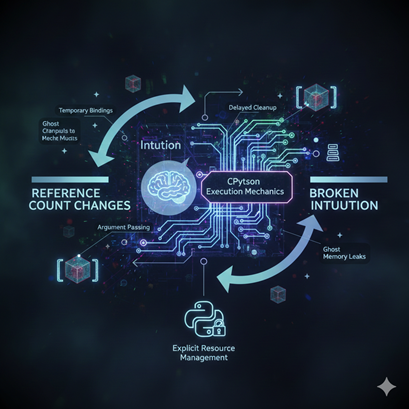
When Reference Count Changes Break Intuition in Python
Reference counting is often described as simple. A reference is created, the count goes up. A reference disappears, the count goes down. When the count reaches zero, the object is freed.
In practice, Python’s reference count does not change where most developers expect it to. Counts increase during expression evaluation, temporary binding, argument passing, and even during debugging or logging.
This creates a class of bugs that feel non deterministic. Objects stay alive longer than expected. Destructors run later, or not at all. Memory appears to leak, then suddenly drops.
These behaviors are not edge cases. They are direct consequences of how CPython executes code and manages references.
Short Summary
Reference counting in Python does not change where most developers expect it to.
In CPython, reference counts rise and fall during expression evaluation, argument passing, and stack operations, not just on assignment or deletion.
This mismatch between mental models and execution timing explains why objects outlive expectations, destructors are delayed, and memory behavior appears buggy despite being deterministic.
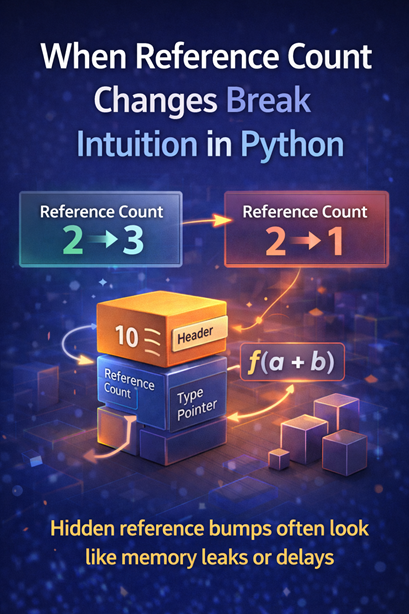
Summary Card
Reference Count Timing in Python
- Reference counts change during evaluation, not just assignment and deletion.
- Temporary references are created more often than most developers assume.
- Argument passing and return values introduce hidden reference increments.
- Unexpected refcount timing often looks like a memory leak or delayed cleanup.
- These behaviors follow directly from CPython’s execution model.
Problem definition
Developers often observe that objects remain alive longer than expected.
Destructors are delayed. Weak references do not clear when anticipated. Memory usage appears to grow even though references were explicitly removed.
These issues frequently surface when relying on deterministic cleanup, object finalization, or precise lifetime control.
The root cause is almost always an incorrect assumption about when reference counts actually change.
The common wrong assumptions
The most common assumption is that reference counts change only on assignment and deletion.
Another assumption is that temporary expressions do not materially affect object lifetime.
Both assumptions are wrong in CPython. Reference count changes are tightly coupled to evaluation order and stack behavior, not just variable names.
This gap between the mental model and the runtime model is where bugs emerge.
What actually happens inside Python
CPython uses reference counting as its primary memory management strategy.
Every time an object reference is pushed onto the evaluation stack, the reference count is incremented. When it is popped, the count is decremented.
This includes temporary values created during expression evaluation, function calls, and return handling.
For example, passing an object as a function argument increments its reference count before the function body executes. The decrement happens only after the call frame is unwound.
Similarly, intermediate results in chained expressions hold references until the entire expression completes.
The timing is deterministic, but it is not aligned with source level intuition.
Why Python is designed this way
Reference counting is deeply integrated into CPython’s execution engine.
Incrementing and decrementing references during stack operations simplifies memory management and enables immediate reclamation when counts reach zero.
The cost is that object lifetime becomes tied to evaluation mechanics rather than variable scope.
This design favors predictable execution and simple garbage collection over intuitive lifetime boundaries.
Anti patterns that make it worse
Relying on destructors for resource management amplifies refcount timing issues.
Debugging tools that introspect objects can themselves extend object lifetime.
Assuming that deleting a name immediately frees an object often leads to misleading conclusions.
Stable design strategies
Design systems so correctness does not depend on exact object destruction timing.
Use explicit resource management patterns where cleanup timing matters.
Treat reference counting as an implementation detail, not a contract.
The decision point is whether lifetime precision is a requirement or an assumption.
Conclusion
Reference count changes in Python follow execution mechanics, not source level intuition.
The behavior is deterministic, but the timing often surprises experienced developers.
Most refcount related bugs come from assuming lifetime boundaries that do not exist.
Understanding when references are created and released explains why these bugs occur.
Related posts
- Why Everything Is an Object in Python
- Why Python Garbage Collection Feels Unpredictable
- What Actually Happens During Function Calls in Python