Why Python Garbage Collection Looks Like It Is Not Running
Many Python developers assume that a garbage collector is constantly scanning memory and reclaiming unused objects. When memory usage stays flat or keeps growing, it feels like the collector is stalled or broken.
This impression becomes stronger when manual calls to the garbage collector appear to do nothing. Objects remain alive. Memory does not immediately return to the system.
From the outside, it looks like Python’s GC is simply not running.
In reality, most object reclamation in Python does not involve the garbage collector at all.
Short Summary
Python’s garbage collector often appears inactive because it is not responsible for most object cleanup.
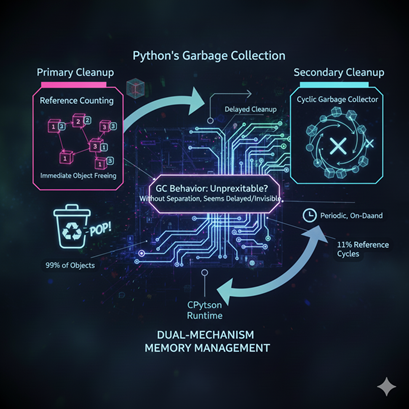
In CPython, reference counting frees the majority of objects immediately, while the cyclic garbage collector runs only to break reference cycles.
Without separating these two mechanisms, GC behavior looks unpredictable, delayed, or invisible.
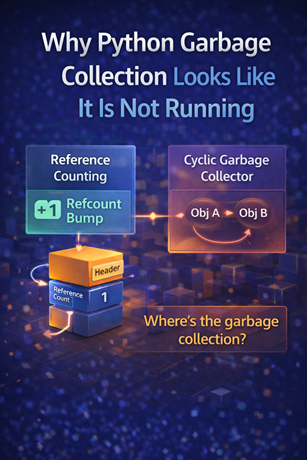
Summary Card
Why Python GC Feels Invisible
- Most Python objects are freed by reference counting, not by the garbage collector.
- The cyclic GC only runs to break reference cycles, not to manage general lifetime.
- Objects without cycles are reclaimed immediately when their reference count reaches zero.
- Manual GC runs often appear ineffective because there are no cycles to collect.
- This separation makes GC activity hard to observe in everyday code.
Problem definition
Developers often observe that memory usage does not drop after objects go out of scope.
Calling gc.collect() frequently returns zero, even when many objects were recently discarded.
This leads to the conclusion that the garbage collector is not working or not running often enough.
The confusion comes from treating Python’s GC as a general memory manager.
The common wrong assumptions
A widespread assumption is that Python’s garbage collector is responsible for freeing most objects.
Another assumption is that object lifetime is primarily governed by periodic GC cycles.
Both assumptions are incorrect in CPython. Garbage collection plays a secondary, specialized role.
Without separating reference counting from cyclic GC, the behavior looks inconsistent.
What actually happens inside Python
CPython uses reference counting as its primary memory management mechanism.
When an object’s reference count reaches zero, it is destroyed immediately. No garbage collection cycle is involved.
The cyclic garbage collector exists solely to detect and break reference cycles that reference counting cannot resolve.
Most objects never participate in cycles. They are created, used, and freed entirely through reference count changes.
The cyclic GC runs periodically based on allocation thresholds, not on scope exits or memory pressure.
As a result, its activity is both infrequent and narrowly targeted.
Why Python is designed this way
Reference counting provides immediate and predictable object destruction.
This enables deterministic resource cleanup and simplifies interpreter design.
Cyclic garbage collection is layered on top to handle the specific case where reference counting fails.
The separation keeps the fast path simple and avoids the overhead of full heap scans.
Anti patterns that make it worse
Using memory usage alone as a proxy for object lifetime often leads to false conclusions.
Forcing garbage collection in performance critical paths introduces overhead without benefit.
Expecting cyclic GC to behave like a general purpose collector creates incorrect expectations.
Stable design strategies
Design systems assuming that reference counting handles most object lifetimes.
Use cyclic GC awareness only when reference cycles are intentionally created.
Separate resource management concerns from garbage collection mechanics.
The key decision is whether cycles exist, not whether GC is running.
Conclusion
Python’s garbage collector appears invisible because it is not responsible for most object cleanup.
Reference counting dominates object lifetime in CPython.
Cyclic GC runs rarely and only for a specific class of problems.
Once these roles are separated, the behavior becomes predictable.
Related posts
- Why Everything Is an Object in Python
- When Reference Count Changes Break Intuition in Python
- Why Python Garbage Collection Feels Unpredictable