Why Shallow and Deep Copy Fail in Real Python Code
Copying objects in Python feels like a solved problem. A shallow copy duplicates the container. A deep copy duplicates everything. The intent seems clear.
In practice, copied objects still leak state. Mutations propagate unexpectedly. Performance degrades. Subtle bugs survive testing and surface later in production.
This creates a false sense of safety. The code “uses copy,” yet isolation is incomplete.
The failure is not misuse. It follows from how Python defines object identity, references, and copy semantics.
Short Summary
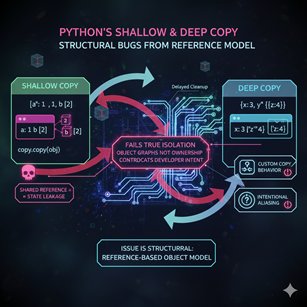
Shallow and deep copy in Python often fail to provide true isolation because copying operates on object graphs, not ownership boundaries.
Shared references, custom copy behavior, and intentional aliasing allow state to survive copy operations in ways that contradict developer intent.
The resulting bugs are structural, rooted in Python’s reference-based object model rather than incorrect usage.

Summary Card
Why Copy Feels Safe but Is Not
- Shallow copy duplicates containers but preserves references to contained objects.
- Deep copy relies on traversal rules that are incomplete and context dependent.
- Object identity and shared references survive many copy operations.
- Custom types often redefine copy behavior in unexpected ways.
- The safety of copying depends on object graphs, not on intent.
Problem definition
A structure is copied to isolate state.
Later, changes to one instance affect another. Nested objects reflect mutations across boundaries. Debugging points back to code that “clearly copied” the data.
In other cases, deep copy succeeds but introduces severe performance or memory overhead.
Both outcomes violate the expectation that copying establishes independence.
The common wrong assumptions
A common assumption is that shallow copy is unsafe but deep copy is safe.
Another assumption is that deep copy recursively duplicates everything by default.
Both assumptions are flawed. Python does not define copying in terms of semantic independence.
It defines copying in terms of object graphs and reference preservation rules.
What actually happens inside Python
In CPython, objects are connected through references, not ownership.
A shallow copy creates a new container object and copies references to the same underlying objects.
A deep copy walks the object graph and attempts to duplicate reachable objects.
This traversal is constrained. It respects memoization, custom copy hooks, and type specific behavior.
Some objects are intentionally shared. Others cannot be copied meaningfully. Cycles require special handling.
The result is a copy that is structurally consistent, but not necessarily isolated.
Why Python is designed this way
Python prioritizes flexibility over strict ownership semantics.
Objects do not declare exclusive ownership of their contents.
This allows shared references, cycles, and aliasing to exist naturally.
Copy operations must respect these properties or risk breaking invariants.
Anti patterns that make it worse
Assuming deep copy is a universal safety mechanism creates hidden coupling.
Copying large object graphs to enforce isolation introduces unnecessary cost.
Relying on copy behavior across library boundaries amplifies unpredictability.
Stable design strategies
Design data structures with explicit ownership boundaries.
Prefer immutability for shared data.
Isolate mutation behind clear interfaces rather than relying on copying.
The key decision is whether isolation is structural or accidental.
Conclusion
Shallow and deep copy fail because copying is not the same as isolation.
Python copies references according to object graph rules, not developer intent.
Understanding this distinction explains why copy based designs break down.
Safe systems rely on architecture, not on copying as a defensive tool.
Related posts
- Why Mutable Default Arguments Are Structurally Dangerous in Python
- Why Everything Is an Object in Python
- When Reference Count Changes Break Intuition in Python
- Why Python Garbage Collection Looks Like It Is Not Running